What Is a Kilim Rug? Origin, Materials, and How to Choose One
A kilim (pronounced kih LEEM) is a flatwoven rug or textile in which the pattern is woven directly into the fabric, with no pile and no backing. The word comes from a Persian term for a flatwoven cover. Kilims are woven across Turkey, Iran, the Caucasus, Central Asia and India, where weavers in Rajasthan make them by hand.
A kilim rug is a flatwoven rug made from wool, cotton, or jute, where the pattern is built directly into the weave itself rather than added afterward. Unlike a knotted or tufted rug, a kilim has no pile, no backing, and no glue holding it together. It is entirely interlocked thread, which is what gives it a thin profile, a slightly textured surface, and, in most cases, a design that looks the same or nearly the same on both sides.
In India, and specifically in Rajasthan, kilim weaving has been passed down through generations of artisan families, who still work by hand on traditional looms rather than industrial machines.
How a Kilim Rug Is Actually Made
Weaving a kilim starts with vertical threads, called the warp, stretched tightly across a wooden loom. The weaver then interlocks horizontal threads, the weft, over and under the warp in a specific pattern, building up color blocks row by row. Where two colors meet, the weaver either interlocks the threads directly or leaves a small slit, depending on the technique, which is why kilims are sometimes called slit weave rugs.
Are Kilim Rugs Durable?
Yes. A kilim has no pile to crush and no backing to peel, so it holds up well in hallways and living rooms. Wool and jute add strength, and flipping or rotating the rug every few months spreads wear evenly.
How to Clean a Kilim Rug
1. Vacuum on low suction without a beater bar.
2. Blot spills with a clean damp cloth, working from the edge toward the center.
3. Use a little mild soap only on stubborn marks and blot it out again.
4. Let the rug dry flat, away from direct sun. 5. Rotate it every few months.
Kilim Definition
A kilim is a flatwoven rug or textile in which the pattern is woven directly into the fabric, with no pile and no backing.
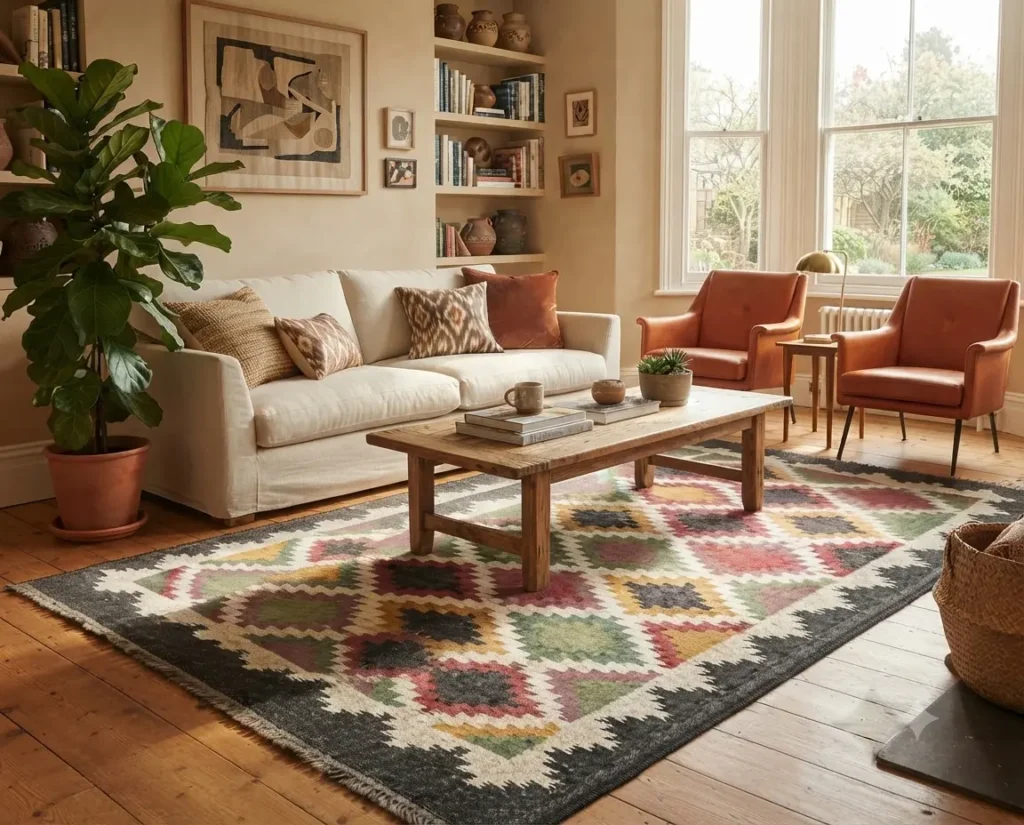
This process is slow. A single kilim rug, depending on its size and pattern complexity, can take several days to complete on the loom, entirely by hand. There is no shortcut version of this process. A machine-made rug with a printed pattern is not a kilim, regardless of how it is marketed.
Are Kilim Rugs Geometric Rugs?
Yes, most kilim rugs are geometric, because the flatweave builds designs from stepped blocks of color. Most traditional kilims use geometric motifs such as diamonds, zigzags and stripes, because the weave builds a design from stepped blocks of colour. Not every kilim is strictly geometric, though. Some designs are more abstract or use simple floral shapes. If you like clean lines, look at our geometric rug designs, and for softer looks try our boho area rug styles.
Kilim Rug vs Other Rug Types
Since many customers shopping internationally are unfamiliar with the differences, here is a direct comparison.
| Type | How it is made | Pile | Reversible | Typical feel |
| Kilim | Flatwoven, pattern woven into the fabric | None | Often | Thin and textured |
| Dhurrie | Traditional Indian flatweave, often cotton or wool | None | Often | Thin and flexible |
| Tufted rug | Yarn punched through a backing and glued | Yes | No | Plush |
| Knotted rug | Knots tied row by row into a foundation | Yes | No | Dense pile |
If you are looking for a flatweave rug with a flat profile, natural texture, and the option to flip it for even wear, a kilim is generally the right category to shop in.
What Materials Are Used in a Kilim Rug
Most kilim rugs use one of the following combinations.
Wool is the most common material for the pattern itself, chosen for its durability and natural texture. Jute is often used as a secondary fiber, as in our wool jute area rug, adding strength and a slightly coarser, more natural finish. For a thicker jute look, see our hemp rug page, which covers hemp style jute weaves. Some kilim rugs use cotton instead of or alongside wool, which tends to produce a smoother, lighter weight rug, like a handmade cotton rug. Because the materials are natural fibers rather than synthetic ones, kilim rugs generally hold up well over years of use, provided they are cared for properly. For a hand braided jute option, see our braided rug range.
How to Choose the Right Kilim Rug for Your Home
Start with the room, not the rug. A kilim rug’s flat profile makes it a practical choice under furniture, which is why it works especially well in living rooms, dining areas, and hallways where chairs and tables move frequently across the floor. Our rug size guide shows which size suits each of those rooms.
Think about pattern density before color. Kilim rugs range from bold, high-contrast geometric patterns to softer, more muted designs. If the rest of a room already has a lot of visual texture, such as patterned cushions or a busy wall, a simpler kilim pattern will balance the space better than layering on a second bold pattern.
Check whether the rug is reversible. Most kilim rugs show the same pattern on both sides, so you can flip them to spread wear. All Nexuzy kilim rugs are flatwoven and can be used on either side.
Consider a custom size before settling for close enough. Because kilim rugs are often woven to order, an oddly shaped room, a narrow hallway, or an extra-large living room doesn’t have to mean compromising on standard dimensions.
Where to Shop Kilim Rugs
Every kilim rug in our collection is a handwoven Indian rug, made in Rajasthan, India, using the traditional flatweave technique described above. The collection includes boho, tribal, geometric, and dhurrie style patterns, available in sizes from 2×6 ft to 9×12 ft, with a custom size kilim rug available on request. Every order ships free to the USA, UK, Canada, Australia, and worldwide, typically arriving within 3 to 5 days.
Browse the full collection on our Kilim Rug page, Looking for seating instead? See our kilim bench collection. or buy kilim rugs online from the full shop
Frequently Asked Questions
What is the difference between a kilim rug and a regular rug?
A kilim rug is flatwoven, meaning the pattern is built directly into the weave with no pile, backing, or glue involved. Most regular rugs sold in stores are tufted, which means yarn is punched through a fabric backing and then glued in place, giving them a thicker pile but no reversibility.
Are kilim rugs good for high-traffic areas?
Yes. The flat, tightly woven construction of a kilim rug makes it well suited to hallways, entryways, and living rooms where foot traffic is frequent. Many kilim rugs are also reversible, which allows you to flip the rug periodically to spread out wear evenly.
Is a kilim rug the same as a dhurrie?
They are closely related. Dhurrie is the traditional Indian term for a flatwoven rug, and kilim is the broader term used across several weaving cultures. In practice, a traditional Indian dhurrie rug and a kilim rug from India are made using the same core technique.
Can a kilim rug be used outdoors?
Kilim rugs made from wool, cotton or jute are meant for dry indoor use. A covered porch is possible for a short time if the rug stays dry, but rain, damp and direct sun damage natural fibers.
How long does a handmade kilim rug take to arrive if ordered internationally?
Every kilim rug ships free to the USA, UK, Canada, Australia and worldwide. We dispatch within 1 to 2 business days, and delivery usually takes 3 to 5 business days after dispatch.
Do kilim rugs shed?
Kilim rugs generally do not shed the way pile or shag rugs can, since there is no loose pile fiber to begin with. Light fiber shedding is possible with a brand new rug during the first few uses, but it settles quickly with normal vacuuming.
What does kilim mean?
Kilim means a flatwoven rug or textile, and the word comes from a Persian term for a flatwoven cover.
How do you pronounce kilim?
Most people say kih LEEM, with the stress on the second part.
By Pushpendra Singh Chouhan, founder of Meera Exports. Published 23 August 2026. Last updated 21 September 2026.