
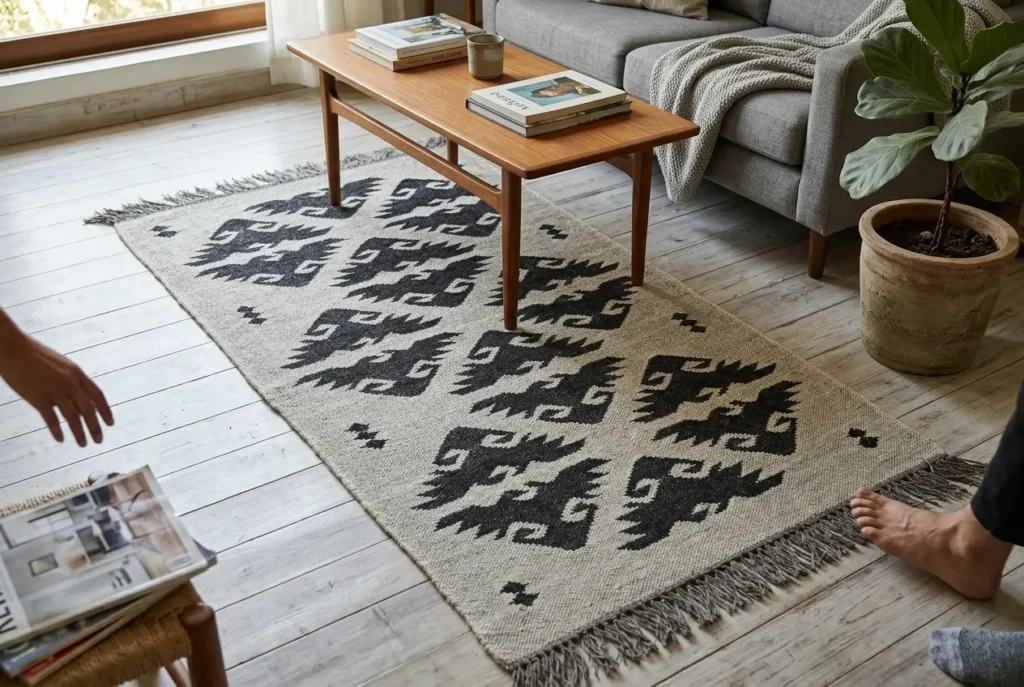
What Is a Flatweave Rug? Kilim vs. Dhurrie, Explained
Walk into any home decor store or scroll through Pinterest for more than a few minutes, and you’ll run into the word “flatweave” attached to half the rugs you see. But what does it actually mean, and how is it different from a kilim or a dhurrie? If you’ve been searching for a rug and keep seeing these three words used almost interchangeably, this guide will clear it up for good.
What Is a Flatweave Rug?
A flatweave rug is exactly what it sounds like: a rug woven flat, with no pile (no fuzzy or looped fibers standing up from the surface). Instead, the weft threads are woven tightly over and under the warp threads, creating a thin, reversible textile with a pattern that’s identical on both sides. This is different from a tufted or knotted rug, which has a raised pile created by looping or knotting fibers into a backing.
“Flatweave” is really an umbrella term. It describes a technique, not a specific style or origin. Kilims and dhurries are both types of flatweave rugs, made using this same basic method, but with different histories, patterns, and regional roots.
Flatweave vs. Kilim vs. Dhurrie: What’s the Difference?
Here’s the simplest way to think about it:
Flatweave is the general weaving technique (no pile, reversible, tightly woven). Kilim is a specific style of flatweave rug that originated in Turkey, Persia, the Caucasus, and Central Asia. Kilims are known for bold geometric motifs, a slit tapestry technique (where color blocks meet at sharp edges rather than blending), and symbolic patterns passed down through generations of weavers. Dhurrie is a flatweave rug that originated in India, traditionally woven from cotton or wool. Dhurries tend to favor simpler stripes, grids, and geometric repeats, and were historically used as floor coverings, bedding layers, and even meditation mats before becoming a global home decor staple.
In short: every kilim and every dhurrie is a flatweave rug, but not every flatweave rug is a kilim or a dhurrie. Think of “flatweave” as the category, and “kilim” and “dhurrie” as two of its most famous members.
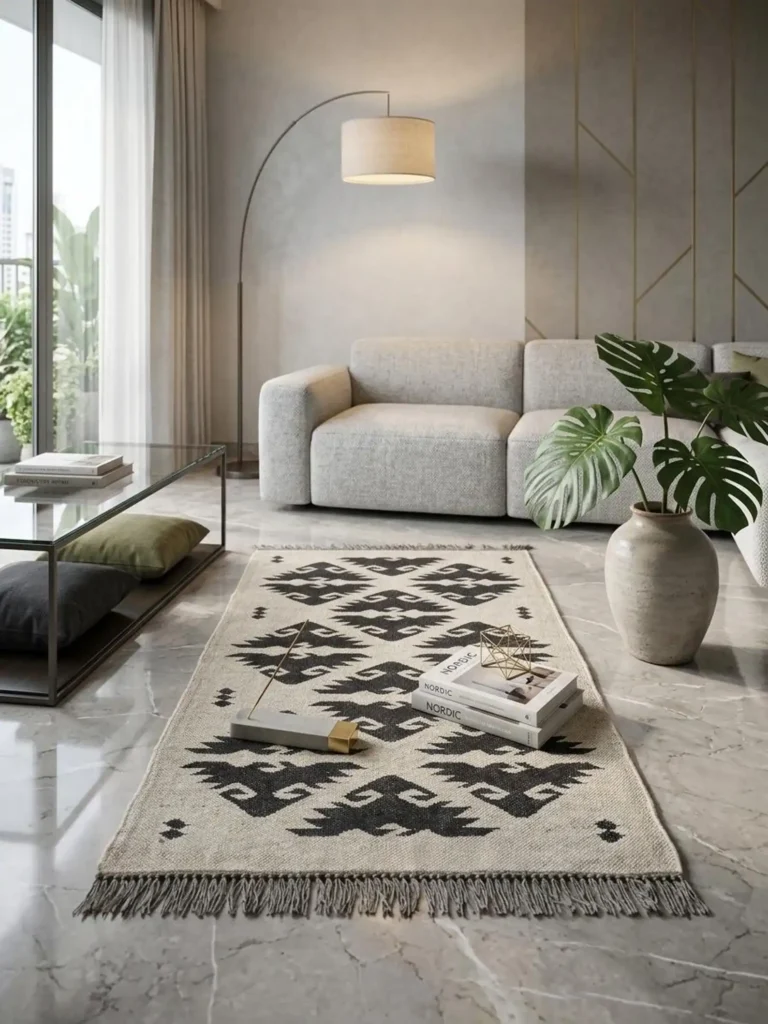
Why Flatweave Rugs Are Having a Moment
A few real reasons flatweave rugs keep showing up in modern homes:
They are lightweight and easy to move. No thick padding means they’re simple to reposition, roll up for travel, or swap seasonally. They are reversible. Flip one over when one side fades or wears, effectively doubling its lifespan. They layer beautifully. Their thinness makes them perfect for layering over a jute rug or sisal base for texture without bulk. They are naturally durable. The tight weave holds up well in busy spaces without shedding as some pile rugs do. They fit multiple aesthetics. The same rug can read as boho, tribal, farmhouse, or eclectic modern depending on how it’s styled.
How to Style a Flatweave Rug in Your Home
In the living room, anchor a seating area with a larger flatweave (8×10 or 9×12 ft), letting the front legs of your sofa and chairs rest on it. In the bedroom, a runner-style flatweave alongside the bed adds warmth underfoot without competing with bedding patterns. In an entryway or hallway, because they’re low-profile and durable, flatweaves are ideal for high-traffic runners where thick pile rugs would bunch up. In the kitchen, a washable or easy-to-clean flatweave in front of the sink handles spills better than a plush alternative.
Choosing the Right Size
A 5×8 ft rug works well under a coffee table in smaller living rooms. An 8×10 ft rug is the standard for anchoring a full living room seating arrangement. Runners, typically 2×6 to 2.5×8 ft, are ideal for hallways, entryways, and alongside beds. Always measure your space first, and aim for at least 6 to 8 inches of bare floor showing around the rug’s edge in a living room for a balanced look.
Caring for a Flatweave Rug
Because there’s no pile to trap dirt, flatweaves are genuinely simple to maintain. Shake or vacuum them regularly (no beater bar; use a suction-only setting or a low pile setting). Spot clean spills immediately with a damp cloth, and avoid soaking, since natural dyes can bleed if oversaturated. Rotate every few months for even wear, and flip occasionally if the weave allows it.
Why Choose a Handmade Flatweave Rug
Machine-made flatweaves exist, but a hand-woven kilim or dhurrie carries something a factory version can’t replicate: slight irregularities in the weave, natural dye variation, and the accumulated skill of a weaver who has made hundreds of these by hand. Each piece takes days to weeks to complete on a traditional loom, and no two are ever fully identical. When you choose handmade, you’re also supporting the artisans and weaving communities keeping this craft alive.
Is a flatweave rug the same as a kilim?
Not exactly. A kilim is a type of flatweave rug. All kilims are flatweaves, but not all flatweaves are kilims (dhurries, for example, are also flatweaves but from a different regional tradition).
Are flatweave rugs good for high traffic areas?
Yes. Their tight, low profile weave holds up well in entryways, hallways, and living rooms, and they're less prone to matting than pile rugs.
Can flatweave rugs be used outdoors?
Traditional wool or cotton flatweaves are best kept indoors or in covered outdoor spaces, since they're not moisture resistant. For fully exposed outdoor areas, look for a rug specifically labeled as outdoor safe.
Are flatweave rugs reversible?
Most are, since the weaving technique produces the same pattern on both sides. This is one of their biggest advantages over pile rugs.
Do flatweave rugs work with underfloor heating?
Yes, their thin profile makes them one of the better rug types for use over underfloor heating, as they don't insulate as heavily as thick pile rugs.
Do you ship flatweave rugs internationally?
Yes. [Adjust based on your actual current shipping policy, for example: we ship to the US, UK, Australia, and Canada.]